RBQ: 5784-4938-01
Choosing a commercial sign is more than just an aesthetic choice. The environment in which your business is located has a direct influence on the type of sign to choose, its dimensions, lighting and even the materials used. A sign installed on a business outside on a street (busy or not) is not subject to the same constraints as a sign located in a shopping center.
Understanding these differences can help you avoid costly mistakes and ensure optimum visibility, while complying with current standards. Here are the main points to consider.
Visibility is one of the first factors to consider when designing a commercial sign, since it directly influences a business’s ability to be spotted and identified quickly. Externally, the sign must make it possible to identify the business at a glance, even in a visually-charged context. Distance legibility, color contrast and the quality of commercial lighting play a decisive role here. A sign that is too discreet, poorly lit or difficult to read risks going unnoticed, particularly when the passer-by is on the move or exposed to several visual stimuli simultaneously.
In a shopping center, the dynamics are different. Customers move around mainly on foot in a controlled environment, where overall signage is designed to guide visitors through aisles and shopping areas. In this case, signage serves more to clearly identify the business and reinforce its brand image than to attract attention from a great distance. In this context, directional signage, combined with visual consistency with the overall site, becomes essential to facilitate customer orientation, ensure a fluid experience and maintain visual consistency throughout the center.
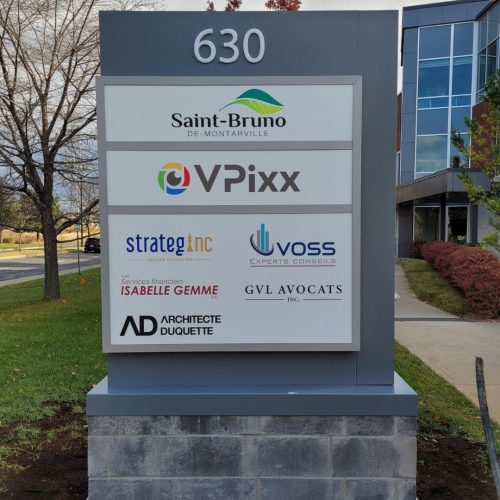
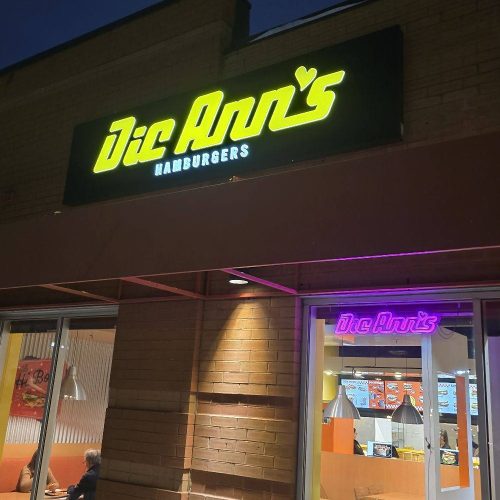
Installation height has a direct influence on the legibility of a commercial sign. In an outdoor context, it must be sufficiently visible without being obscured by obstacles such as trees, lampposts or vehicles. Positioning must also take pedestrians and motorists into account, which may lead to the use of wall-mounted signs, pylons or 3D lettering.
In a shopping center, height and location are often predetermined by the building owner. These parameters are designed to maintain visual uniformity and ensure clear readability for visitors. Retailers generally have less freedom, but benefit from an environment already optimized for pedestrian traffic.
Standards for commercial signs vary according to location and type of installation. For a business facing the street, municipal by-laws not only regulate dimensions, materials, lighting and sign language, but also require that municipal certificates and permits be obtained prior to installation. The purpose of these authorizations is to ensure that the sign complies with urban planning regulations, public safety and visual integration with the surrounding area. Misinterpretation of these requirements can result in permit refusals, additional delays or mandatory post-design adjustments.
In a shopping center, the rules come mainly from the property manager. They are generally detailed in a development guide that imposes precise standards in terms of typography, format, materials and lighting. Although municipal procedures may differ, the mall’s internal requirements are just as important to respect in order to obtain authorization to install the sign.
Since by-laws and permit requirements can vary from one municipality to another, it’s essential to be well informed before embarking on a project. To find out more about municipal obligations, the steps to take and the documents generally required, we invite you to consult our detailed article on municipal regulations for commercial signs.
Each environment imposes its own limits. Outdoors, restrictions are often linked to safety, urban integration and neighborhood protection, particularly with regard to night-time lighting. Inside a shopping center, restrictions are more contractual and aesthetic, limiting certain creative options in order to maintain overall coherence.
These constraints don’t mean a lack of possibilities, but rather the need for thoughtful design adapted to the installation context. By taking into account technical limitations, current standards and the immediate environment, it’s possible to design a high-performance, durable and visually coherent sign, while complying with the imposed requirements.
The choice of sign type should always take into account the environment in which it will be installed. In an outdoor context, illuminated signs, illuminated 3D letters and high-performance lighting systems are often preferred to ensure constant visibility, day and night. In shopping centers, the emphasis is on clarity, legibility at close range and harmonious integration with the overall design of the site.
In all cases, durability, quality of materials and compliance with standards remain essential to ensure the installation’s longevity and the sign’s performance over time. As each project has its own constraints and objectives, it’s important to be well supported right from the design phase.
If you have any questions about the choice, design or implementation of your commercial sign, Xénon Enseignes & Éclairage is the place to go. Don’t hesitate to contact us for advice tailored to your location and needs.
Every commercial signage project involves technical, regulatory and visual issues specific to its environment. An in-depth analysis of the site is essential to design a sign that is adapted, effective and compliant, whether it’s installed on a high-street business or in a shopping center. This approach enables us to anticipate constraints, comply with current standards and optimize sign visibility right from the design stage.
The differences between outdoor and mall signs have a direct influence on the design, positioning and performance of signage. The environment, applicable rules and customer behavior are not the same, requiring adapted choices in terms of design, lighting and format. Understanding these realities enables you to make informed choices and invest in a truly effective commercial sign.
At Xénon Enseignes & Éclairage, we analyze each company’s visibility, regulations, technical constraints and objectives to recommend the most appropriate solution. From design to installation, we work with our customers every step of the way to ensure a sign that performs well, lasts and is aligned with their brand image.
Careful planning and professional guidance make all the difference between a sign that fits in… and one that stands out. Find out more about our services and how we can help you make your signage project a reality, or contact us to discuss your project.